
Summary
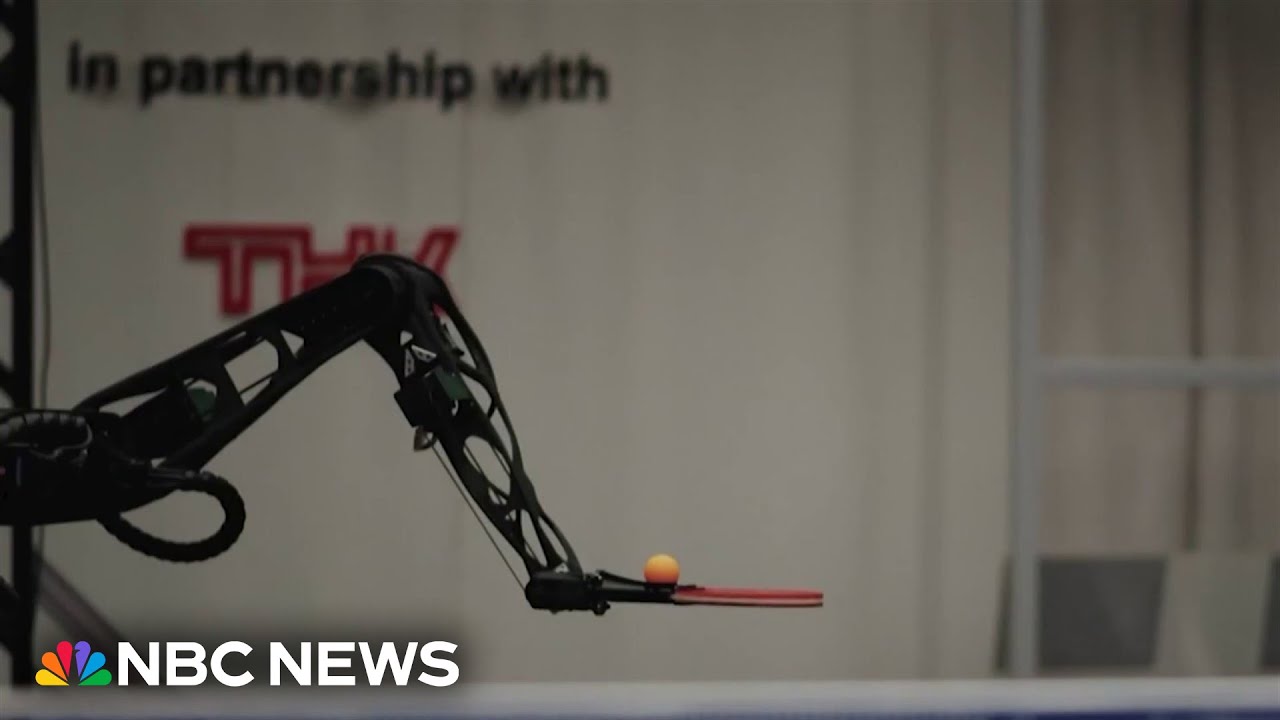
Sony's AI division has developed a table tennis robot called Ace that can beat elite players. According to a study published in Nature, Ace is a significant breakthrough for physical AI. However, comparisons with human players are not without controversy, as Ace is not a humanoid robot. The robot's ability to beat elite players has sparked debate about the future of human competition in sports. [[sony|Sony]]'s achievement is a testament to the rapid progress being made in [[artificial-intelligence|AI]] research. The development of Ace has significant implications for the field of robotics and could potentially lead to advancements in other areas, such as [[robotics|robotics]] and [[machine-learning|machine learning]]. As the technology continues to evolve, it will be interesting to see how it is applied in various fields, including [[sports|sports]] and [[gaming|gaming]].
Key Takeaways
- Sony's AI division has developed a table tennis robot called Ace that can beat elite players
- Ace is not a humanoid robot, but is able to perform tasks that were previously thought to be the exclusive domain of humans
- The development of Ace has significant implications for the field of AI and robotics, and could potentially lead to advancements in other areas
- The development of Ace highlights the potential risks associated with the development of advanced AI systems, including the potential for job displacement and the exacerbation of existing social inequalities
- The development of Ace is a reminder of the need for careful consideration and regulation of the development of AI systems
Balanced Perspective
The development of Ace is a significant achievement for Sony's AI division, but it is not without its limitations. While the robot is able to beat elite players, it is not a humanoid robot and therefore does not have the same physical capabilities as a human. Additionally, the robot's performance is highly dependent on its advanced algorithms and sensor systems, which may not be easily replicable in other contexts. As the technology continues to evolve, it will be interesting to see how it is applied in various fields and how it is received by the public. [[artificial-intelligence|AI]] research is a rapidly evolving field, and it will be important to continue to monitor its development and assess its potential impact on society.
Optimistic View
The development of Ace is a significant breakthrough for physical AI and has the potential to revolutionize the field of robotics. With its advanced algorithms and sensor systems, Ace is able to perform tasks that were previously thought to be the exclusive domain of humans. This technology has the potential to be applied in a wide range of fields, from [[healthcare|healthcare]] to [[manufacturing|manufacturing]]. As the technology continues to improve, we can expect to see significant advancements in these fields, leading to improved efficiency and productivity. [[sony|Sony]]'s achievement is a testament to the power of innovation and the potential for AI to improve our lives.
Critical View
The development of Ace is a concerning development for human competition in sports. If a machine is able to beat elite players, it raises questions about the value of human competition and the potential for machines to replace humans in various fields. Additionally, the development of Ace highlights the potential risks associated with the development of advanced AI systems, including the potential for job displacement and the exacerbation of existing social inequalities. As the technology continues to evolve, it will be important to consider these risks and to develop strategies for mitigating them. [[sony|Sony]]'s achievement is a reminder of the need for careful consideration and regulation of the development of AI systems.
Source
Originally reported by Notebookcheck